
JM Buchet Photography


The Galapagos Islands
In Darwin's Footsteps
After a long fly via Madrid, Quito and Guayaquil, we finally set foot on Baltra Island, the gateway to our Galapagos journey.
After the entry formalities, we boarded a small boat accommodating only sixteen passengers. Eight days of sailing awaited us through the islands of the eastern archipelago, with new stops and landings each day, sometimes on dry land, sometimes with our feet in the water.
Santa Cruz — First Encounters

Our first stop takes us to Santa Cruz Island. We've barely arrived when we head out to meet one of the archipelago's iconic animals: the giant Galapagos tortoises.
Observing them moving freely in their environment is already one of the first memorable encounters of this trip.
Genovesa — The Kingdom of Birds

After a somewhat rough night at sea, we discover the cliffs of Genovesa and our first bird colonies : gannets, red-footed boobies, frigatebirds, storm petrels and red-billed tropicbirds.
From the outset, we are struck by the sheer number of birds in flight and by the intense activity on the ground. We are in the middle of the breeding season: some are still displaying, others are incubating eggs, while many young birds are already well developed.
In the Galapagos, proximity to wildlife takes on a whole new dimension.
At Darwin Bay, our exploration of Genovesa continues, bringing us remarkably close to the wildlife. Darwin’s finches, frigatebirds, red-billed tropicbirds, mockingbirds and lava herons follow one another along our walk.
Bartolomé & Santiago — Volcanic Lands

With Bartolomé and Santiago, the landscape changes radically. Here, the volcanic origin of the Galápagos is striking: cones, craters and vast expanses of lava make up an almost mineral universe.
From the heights of Bartolomé, the view opens onto Pinnacle Rock, one of the most iconic landscapes of the archipelago. On Santiago, at Sullivan Bay, the immense lava flows tell another story — that of a land shaped by volcanic forces.


In some places, the lava slabs resonate under our feet almost like molten metal. The ground appears both extremely solid and surprisingly fragile, riddled with faults and cracks.
These pāhoehoe lava flows, or "ropy lava," create astonishing shapes. Frozen since their cooling, they sometimes give the impression that the rock is still in motion.
The place is striking, almost austere. Under the heat of the sun, the immense mineral expanse further reinforces the impression of a furnace.
Plaza Sur — Land iguanas

On Plaza Sur, east of Santa Cruz, we discover land iguanas. With their yellow and ochre hues, they sometimes seem to blend into the arid landscape that surrounds them.
They are not particularly shy and allow us to observe them at close range, once again illustrating the remarkable relationship with wildlife that characterizes the Galapagos.

Santa Fe — A cactus forest

In Santa Fe, immense Opuntia cacti raise their trunks above arid vegetation and take on astonishing dimensions.
Some look more like trees than the cacti we are familiar with. This unique vegetation gives the island its distinctive appearance.
San Cristobal — León Dormido, Cerro Brujo, Stephens Bay, Los Lobos

As you approach San Cristóbal, you'll see León Dormido, an imposing rock formation rising from the ocean. Its two steep cliffs, separated by a narrow channel, are the remains of an ancient volcanic cone eroded by time and the sea.
Isolated in the middle of the ocean, the rock imposes its presence long before we reach it.

On San Cristobal, at Cerro Brujo, the towering rock formations evoke immense cathedral pillars.

The vast beach of Stephens Bay has some wonderful encounters in store for us. We watch in awe as blue-footed boobies plunge spectacularly into the sea.

Española — Punta Suarez: the kingdom of the albatross

Española is an island we were particularly looking forward to visiting. It is home to the Galapagos albatross, and at this time of year we have the opportunity to observe them at their nesting sites — and to watch them take flight from the cliffs overlooking the ocean.

Blowhole in Punta Suarez
Española — Bahia Gardner: Sea Lion Paradise

On the long white sand beach of Bahia Gardner, it is the sea lions that occupy the space this time. They are everywhere: in the water, on the beach, sometimes only a few meters from us.
Here again, we are the visitors. They are completely unconcerned about our presence.
In a perfectly orchestrated ballet, the madmen once again offer us the spectacle of their dives.

Floreana — Punta Cormorant and the flamingo lagoon
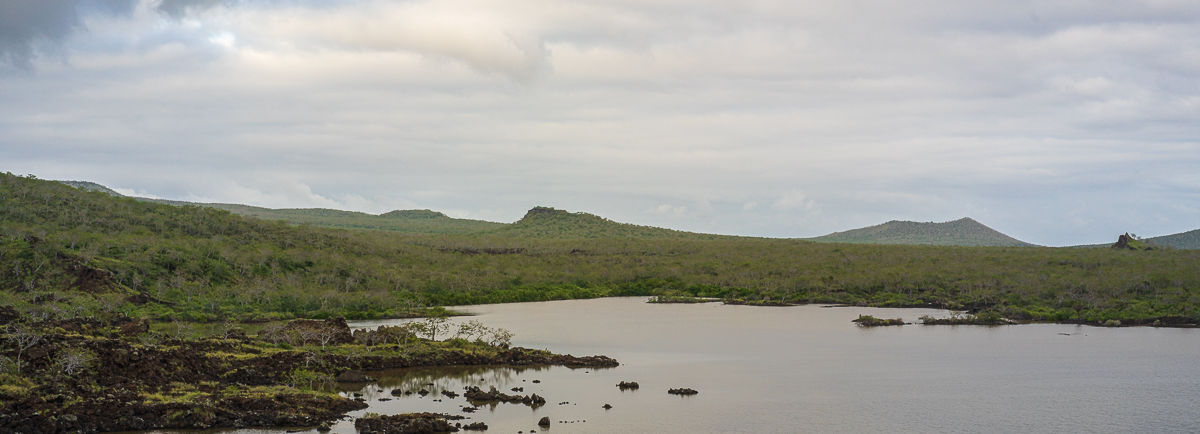
We land on Floreana at a striking beach with greenish hues, caused by the presence of olivine. A little further on, a small lagoon is regularly home to a few pink flamingos.
Their presence is never guaranteed. But today, we are in luck: although quite far away, they are indeed here!

Corona del Diablo — Beneath the surface, another Galapagos discovery


Each day, an hour-long snorkeling trip allows us to discover the Galapagos from a completely different perspective. For me, it's a real discovery: beneath the surface, the spectacle is just as varied and the encounters are often surprising.
Another way to marvel at the richness of the archipelago.
Seymour Norte — A final encounter with wildlife
Seymour Norte is the last island of our journey — a final opportunity to reconnect with the wildlife that has accompanied us throughout the trip and to enjoy once more this extraordinary closeness to the animals.
After eight days of fascinating discoveries and memorable encounters, it is almost time to leave this archipelago that has never ceased to enchant and surprise us.
